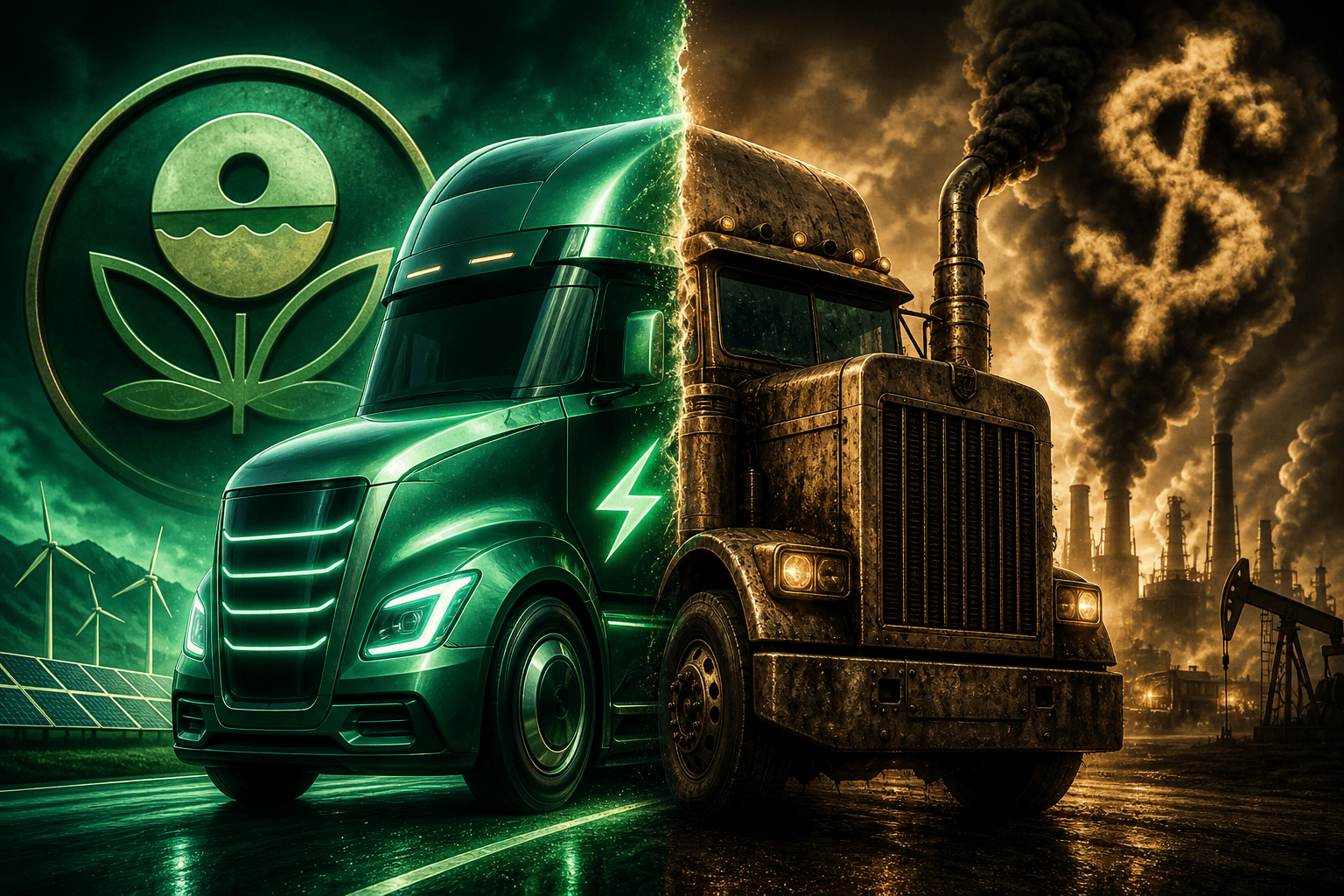
EPA Moves to Roll Back Heavy-Duty Truck Emissions Rules
💡 • Fleet owners: model buy-vs-lease scenarios under both regulatory outcomes before Q4 orders. • Investors: watch engine manufacturers and EV truck startups for divergent regulatory beta. • Logistics startups: pitch route-optimization as margin defense if fuel standards loosen. • Avoid assuming uniform national rules—state preemption fights create compliance arbitrage.
The Trump EPA proposed weakening Biden-era pollution standards for heavy trucks, calling prior rules unworkable. Trucking groups cheered potential cost relief while environmental advocates warn of health and climate setbacks—and fleets face new planning uncertainty.
Heavy-duty trucks move roughly 70% of U.S. freight tonnage, which means emissions rules are economic policy dressed in environmental language. The EPA's proposal to relax Biden-era truck pollution standards opens a fresh fight over compliance costs, manufacturing timelines, and state-level preemption.
Industry groups argue prior targets forced unrealistic retrofit schedules and threatened small carrier margins. Environmental organizations counter that softened rules externalize health costs onto communities near highways and ports. Investors must track both narratives because the winner determines capex cycles for engine makers, trailer manufacturers, and charging infrastructure vendors.
Fleet operators face the hardest near-term decision: buy now under current standards, delay purchases betting on rollback certainty, or accelerate alternative-fuel pilots to hedge either outcome. Used truck markets react quickly when regulatory timelines shift—residual values can swing thousands per unit.
Energy policy intersects here too. Diesel demand trajectories, renewable diesel subsidies, and hydrogen pilot projects all depend on how tight federal tailpipe rules remain. States like California may pursue stricter local standards, creating a patchwork that national carriers hate.
For entrepreneurs, regulatory whiplash is a product opportunity—consulting on compliance pathways, telematics for emissions monitoring, and financing packages tied to upgrade schedules.
Based on reporting from NPR Economy.